
Introduction
The Mobil House building is the head office of MJL Bangladesh Limited (formerly Mobil Jamuna Lubricants Limited), a joint venture between the state-owned Jamuna Oil Company and EC Securities Limited (a subsidiary of the East Coast Group) in Bangladesh. It is a LEED Platinum certified building with office spaces, meeting areas, and conference halls.
This LEED certification has been achieved by following an integrative approach that engaged all key contributors (clients, architects, engineers, energy specialists, and green building consultant) from the early design stage until post-occupancy. The inputs obtained from the varied team members at different stages helped the project achieve its sustainability goals and ensured that the building was efficient as well as cost-effective.
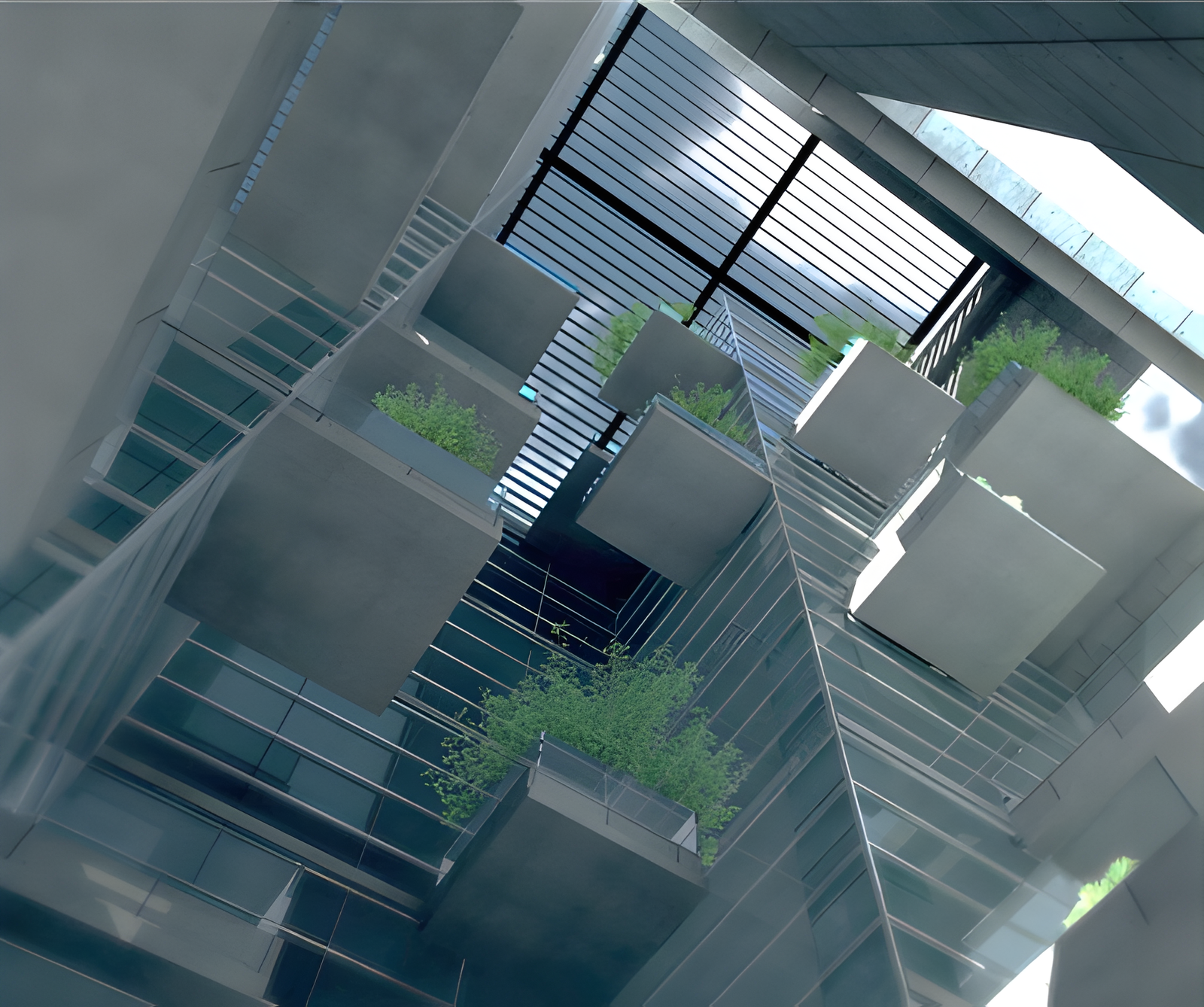
It’s features include sizable courtyards and building cut-outs that are populated with foliage and vertical gardens. The building uses 30% less energy and 50% less water, as compared to conventional office buildings in the region.

| Location | Dhaka |
| Coordinates | 23.8° N, 90.4° E |
| Occupancy Type | Office |
| Typology | New Construction |
| Climate Type | Tropical wet and dry climate |
| Project Area | 6,673 m2 |
| Grid Connectivity | Grid-connected |
| EPI (Environmental Performance Index) | 58 kWh/m2/yr |
Construction Strategies
Passive Strategies
Site Layout & Planning

Due to size constraints of the site, the green cover on site is minimal. However, significant foliage has been incorporated within the large terraces distributed throughout the building. Potted plants and vertical gardens compensate for the lack of surface green cover.
Climate Responsive Design
The most striking feature of the building includes the landscaped and shaded terraces. These act as thermal buffers for the interior spaces.
Form and Massing
The building mass has been oriented such that circulation elements like lift core and staircases are situated along the West façade. This shields the regularly occupied spaces like offices and reception from the solar gains from the west façade. The northeast façade, with less solar gain potential, incorporates large windows to allow daylight and outdoor views.
Facade and Envelope
The envelope is made of 300 mm thick concrete walls, leading to high thermal mass which shields the buildings from heat gain during the daytime. The deep building terraces and courtyards enhance biophilia and create shaded outdoor breakout spaces that remain cool throughout the day. In addition to the walls, the windows – double-glazed panels with low emissivity and a U-value 1.1 W/m2k – also reduce heat gain. The glazing has a shading coefficient of less than 0.25, leading to further reduction in solar heat gain.

Daylight Design
The building form is optimised to let in daylight, blocking solar heat gain. This is done through the deep terraces of the building which provide shading to the north-east façade. This façade, with its row of large windows, also lets in plenty of daylight. A significant number of occupants have access to daylight and views to the outside.

Active Strategies
Optimized HVAC System
An efficient chilled water system has been incorporated in the building HVAC design to significantly reduce cooling energy. The key features of this system are – chiller COP of 6.3, low approach cooling tower with VFD, and energy recovery wheel.
Artificial Lighting Design
The lighting system of the building integrates daylight and occupancy sensors to provide the optimum levels of light during daytime. The sensors detect the ambient daylight levels as well as number of occupants to determine the light output. This is a daytime used building, and the automated lighting controls reduce the peak demand significantly.
In addition, occupants have the controls to customize the lighting levels of their immediate environment, leading to reduced overall lighting load.

Renewable Energy System
The building has an 18 kWp grid-tied solar system on it roof to offset its electrical consumption.
Spread over an area of approximately 240 m2, the system comprises of an array of 60 solar photovoltaic modules. Based on the average solar irradiance received in Bangladesh, it has the potential to generate 24,000 kWh annually.