
Introduction

As China’s construction boom continues and air pollution from coal-fired power plants grows worse, investment in energy-efficient buildings is on the rise. The Shenzhen Institute of Building Research (IBR) Headquarters Building was constructed as a living laboratory and has proven to be a model building for sustainable design, not just for China but throughout the world. It uses modest and simple architecture and incorporates dozens of sustainable strategies, resulting in a building that uses less energy than its Shenzhen peers and comparable U.S. buildings.
Shenzhen is a Nearly Zero Energy Building, with the energy consumption (2014) as follows:
| Annual Energy Use Intensity (EUI) (Site) | 65 kW/ m² (20.6 kBtu/ft2) |
| Natural Gas | 6.6 kW/m² (2.1 kBtu/ft2) |
| Electricity (From Grid) | 54.5 kW/m² (17.3 kBtu/ ft²) |
| Renewable Energy | 3.8 kW/m² (1.2 kBtu/ ft²) |
| Annual Net Energy Use Intensity | 61.16 kW/ m² (19.4 kBtu/ ft²) |
| Heating Degree Days (Base 65°F) | 693 days |
| Cooling Degree Days (Base 65°F) | 3,950 days |
Construction Strategies
The integrated design approach worked with four elements:
- Wind: Natural ventilation in all the office spaces allows for direct contact with nature, and uses 30% less air conditioning;
- Light: Daylight for all the office spaces means no artificial lighting is needed during the day and provides views of the surrounding mountains from all of the workstations;
- Land: A vertical landscape distributed throughout the building doubles the area available for greenery compared to the building’s original footprint. The roof garden, “sky garden,” and patio garden all help restore the ecological balance of the building site; and
- Water: A 43% savings in water consumption, compared to that of similarly sized conventional buildings in Shenzhen, is achieved through use of storm water collection and reclaimed water.
The building’s structural design also helped reduce construction costs. Most commercial buildings in Shenzhen use pile foundations, a design decision based on familiarity and safety. The building uses instead a raft foundation, which greatly reduced construction cost and time by eliminating the need to drill for pillars, while meeting all of the inspections and testing for safety.
The building has recorded remarkably low energy use. The building’s resulting annual electricity cost savings total approximately 700,000 yuan ($105,000) compared to an average similar building in the region.
Design
The team reviewed over 100 sustainable technologies and strategies, and incorporated more than 40 of them, including daylighting; natural ventilation; graywater recycling; solar energy generation; and highly efficient HVAC systems.
Sustainable Strategies
The design team started with the natural ventilation and daylighting principles suitable for their hot summer and warm winter climate. CFD modeling determined the best location, size, and tilt for the windows to ensure optimal natural ventilation that directs airflow above the work surfaces.
Unlike in other areas of China, Shenzhen’s coastal location provides relatively good air quality, allowing for natural ventilation much of the year. Offices with operable windows are located on the upper floors above street-level air and noise pollution.
Similarly, the team designed lightshelves and a building footprint that ensured sufficient daylight for all of the office work spaces. When artificial light is needed, it is provided by T5 lighting, LEDs and some CFL bulbs.
Orientation, Massing, and Organization
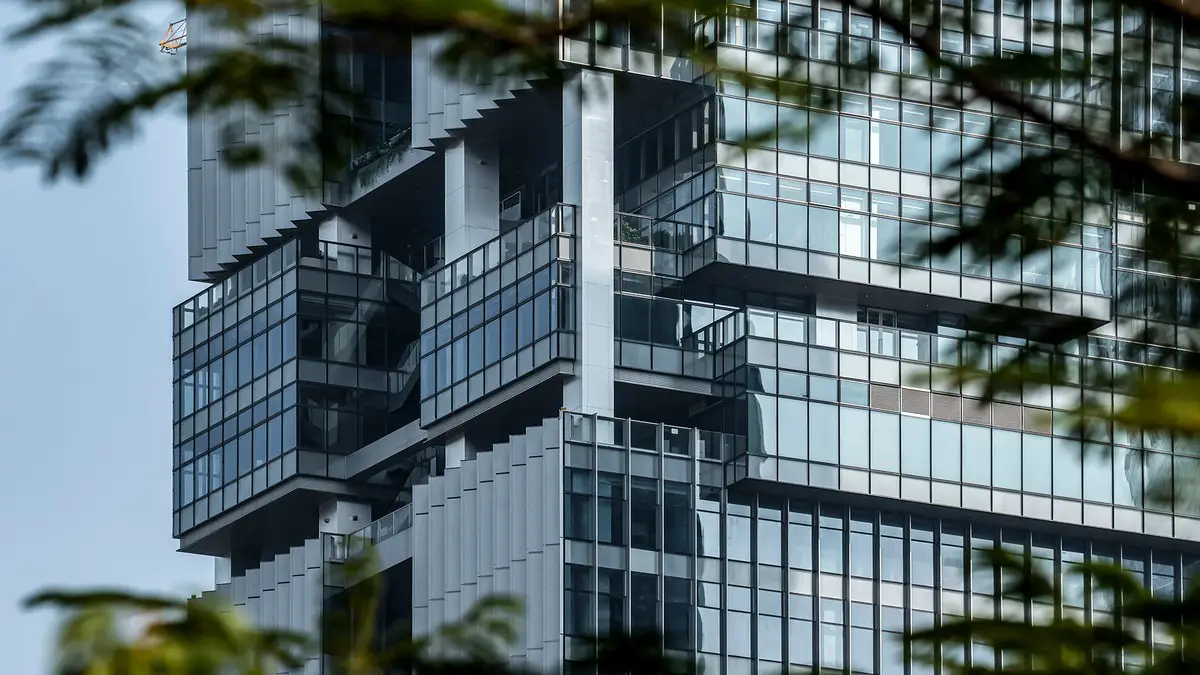
The building is roughly on a northsouth axis to take advantage of the prevailing winds from the east for natural ventilation. PV film and vegetation to provide shade are located on the west elevation. By organizing portions of the building (such as lab areas and office areas) into various blocks and stacking them, the architects were able to create a 12-story outdoor atrium on the east side that captures southeasterly breezes and brings daylight deep inside. Photovoltaic panels covering the atrium provide clean energy—part of China’s first state-level renewable energy demonstration project.
The first floor is the open lobby. The second and third floors are green technology exhibition halls. The fourth floor has testing labs for green materials. The fifth floor is the conference center, and the sixth floor is an open green floor—the “sky garden.” Floors seven through 10 are office space. Floor 11 has rooms for visiting guests. Floor 12 is dining space and floor 13 is the roof garden.
Envelope
The thermal envelope is differentiated on each elevation. The building envelope has low-e double paned windows with frames made from an aluminum alloy, providing good daylight, thermal and acoustic performance.
Different window-to-wall ratios (WWR) are used for different areas of the building. The lower areas of the building are designed primarily for labs and conference rooms, where a WWR value of 0.3 was used for the south, east and north elevations—to minimize daylight impact on lab testing and conference space. For the upper office, a WWR value of 0.7 was chosen to make use of daylight and reduce energy consumption from artificial lighting.
Shading is important for buildings located in China’s hot summer/ warm winter climate region, and the IBR Headquarters Building adopted different shading strategies for different elevations. Overhangs with interior window shades are used for offices.

Vegetation is grown on the 13th floor nursery, and is used throughout the building’s interior and exterior, providing shade for parts of the building’s west-facing façade. The opaque part of the building envelope applies insulation materials and aluminum exterior finishing on cast concrete, which makes the building envelope easy to clean and maintains good thermal integrity.

The west side of the building façade is integrated with thin film PV panels. This PV-integrated façade has a visible transmittance of 0.2, which maintains acceptable visibility while harvesting renewable energy for building operations. Renewable Energy The building includes a variety of PV systems, small wind turbines and a solar thermal system. Various technologies were chosen to demonstrate different applications of building-integrated solar.
The photovoltaic system consists of rooftop PV panels, PV modules on overhangs and the thin film PV system on the building’s west façade. Most of the PV arrays are composed of monocrystalline silicon PV modules, while translucent amorphous modules are used on the building façade to allow daylighting as well as shading. The building also has a standard solar hot water array.
These PV systems generate roughly 70,000 kWh of electricity per year. A solar thermal system collects and stores heat for all of the hot water used for the building’s kitchen and guest hotel rooms.
Heating and Cooling Systems
The IBR Headquarters Building uses a high-efficiency HVAC system. Because the building is located in a hot and humid subtropical area, moisture control is important for indoor thermal comfort. The building uses a temperature- and humidity-independent control system to treat outdoor air.
A dedicated outdoor air system is used to dehumidify outdoor air. This system also allows the terminal equipment to just provide the sensible cooling load of the building.
Different HVAC systems accommodate different cooling needs. For example, the basement and first floor use a water source heat pump (WSHP). The heat pump is located near the landscaped water pool, so the closed-loop condenser water exchanges heat directly with the landscaped water pool, which further reduces condenser water temperature while increasing WSHP system efficiency.
The designers included an experimental radiant cooling system for one section of the building, but disconnected it after they had trouble controlling condensation on the tubing. Building operators have learned that the building needs to be very airtight during the air-conditioning season to avoid condensation.
The rest of the floors use high performance water-supply chillers (18°C [63°F]) CHW supply temperature), with solution-based dehumidification air-handling units and fan-coil units. Since the CHW temperature is high, the fan-coil units just manage the building’s sensible heat load, a design that avoids condensing moisture and saves energy used for latent heat.
Examining Building Performance
The building’s highest energy consumption is during summer, due to the air conditioning, and the base load consumption is also high, due to the larger servers that store energy data for commercial buildings in Shenzhen. The total energy use for the building in 2011 was 1,151,033 kWh, 84% of which came from the city grid. Roughly 10% of the energy used in the building was supplied by city gas mains, and 6% from the building’s PV array.
The largest end use (36%) is the electricity to run the servers and other IT equipment. The next largest is air conditioning (21%) followed by “other” (17%), a category that includes laboratories, apartments, showers, exhibition center and elevators. Lighting, plug loads, mechanical systems and the kitchen account for the remainder of the building’s energy use.
The building was predicted to use 33 kWh/m 2 (10 kBtu/ft2) for air conditioning, but the actual AC energy use in 2011 was 14 kWh/m2 (4 kBtu/ft2), less than half the predicted use. The likely reason for this difference is that the predicted AC energy is calculated based on the Chinese commercial design standard that assumes a fully air-conditioned building and does not account for the building’s natural ventilation system.
The IBR Headquarters Building is designed to maximize use of daylighting, which includes the use of daylighting tubes in the basement. Occupants and staff turn off lights and plug loads on weekends and during periods of low occupancy. The submetered data show that lights and plug loads are well controlled, with very low energy consumption on nights and weekends.
Maintenance and Operations
The building operators report that they enjoy working in the building, particularly the natural ventilation and extensive daylight. They have had to learn how to operate the building, as there is no manual for how to operate a “green” building.
They rely on constant checking of equipment and systems, and are looking forward to the installation of a building management system, which will give them detailed information on systems performance. They acknowledged that there is not a lot of familiarity with the heat pump systems and other innovative systems like the radiant cooling, and that they have had to “learn by doing.”