
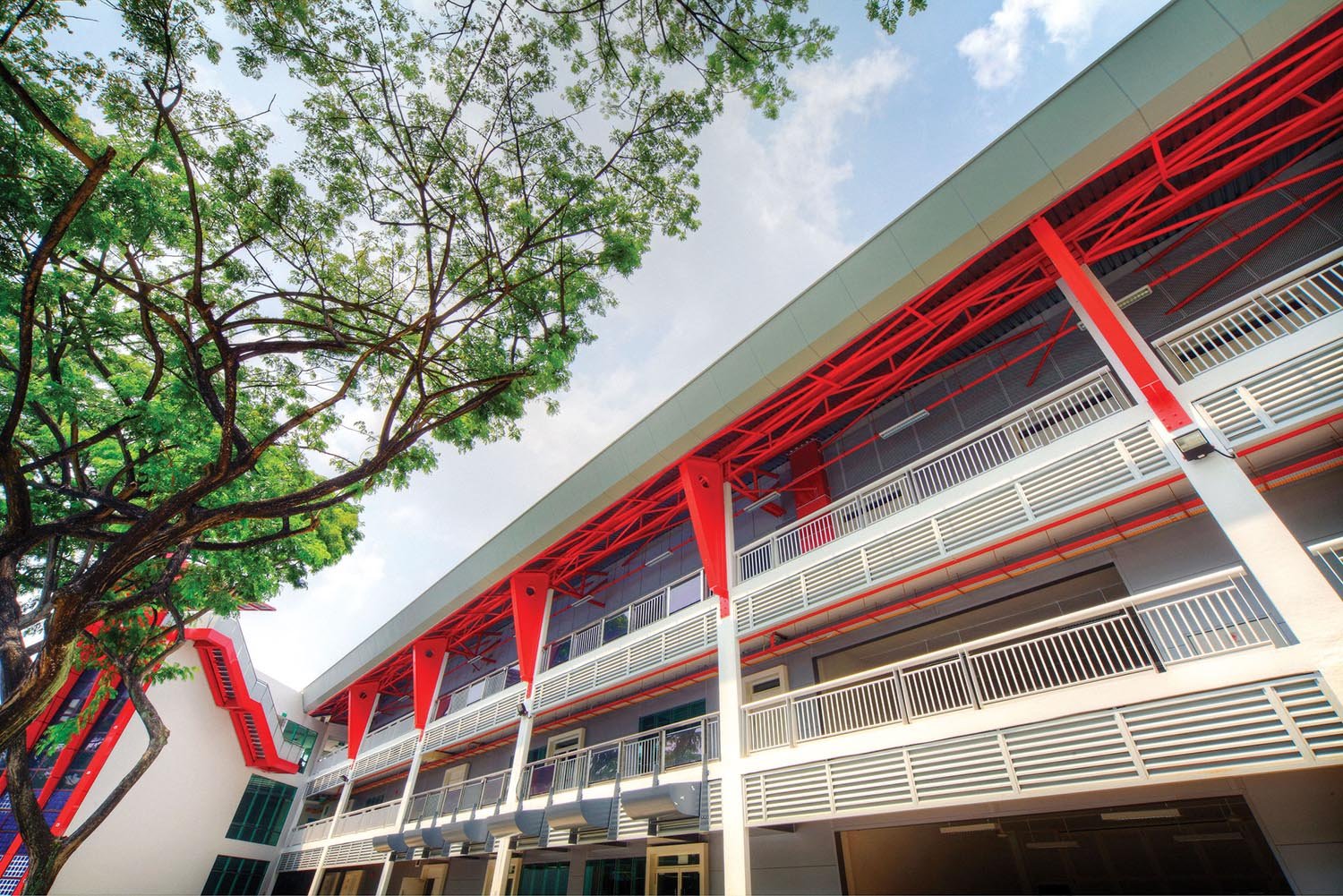
Introduction
| Location | Braddell Road Campus, Singapore |
| Occupancy Type | Office, Academy |
| Climate Type | Tropical Rainforest |
| Project Area | 4500 ft2 |
| Energy Efficiency | 23 kWh/ m²/ 2 years |
BCA is an agency under the Singapore Government’s Ministry of National Development and is tasked with developing green technologies to meet the goal of making 80 percent of all Singapore’s buildings green by 2030. ZEB is BCA’s flagship project and the first net-zero energy building in Singapore.
Throughout its conceptualisation, design, implementation and operation, ZEB encompasses two general integrated approaches to maximise the reduction of energy consumption:
- Passive Design for the Tropics, and
- Active Solutions with Optimised Control
Some key features and achievements of ZEB include:
- Integrating more than 30 innovative technologies ranging from passive to active systems, such as the solar assisted natural ventilation, mirror duct, Single-Coil Twin Fan (SCTF), displacement ventilation, smart lighting control, building integrated photovoltaics (BIPV), etc, many of which were adopted for the first time in the region
- Achieveing a consecutive 9 years of net zero energy performance since 2009
- Delivering an outstanding energy saving of 52% over a typical building in Singapore, with an average Energy Utilisation Index (EUI) of 43 kWh/m2/year
- Receiving a number of international awards, including ASEAN Energy Awards, IES Award, etc
When the Building and Construction Authority (BCA) in Singapore needed to retrofit its three story building on the BCA Academy campus, it decided to try to make it a net zero energy building despite the challenge of doing so in a hot and humid tropical climate. BCA manages Singapore’s Green Mark building rating system and wanted the project to reflect the best sustainable building practices. After five years of operation, the net zero energy targets are being met and occupants are benefiting from the increased visual and thermal comfort.

Construction Strategies
Integrated Approach
The planning began in 2007 as a public-private partnership project with the building owner (BCA), local designers/consultants and builders partnering with researchers from the National University of Singapore (NUS) and the Solar Energy Research Institute of Singapore (SERIS) to retrofit an existing building into a net zero energy building. The building footprint is about 250 ft (76 m) long and 65 ft (20 m) deep, with an external corridor on the longer east side providing access to the deep building spaces on all three stories.
In design charrettes the stakeholders discussed passive design, energy efficiency and renewable energy. International case studies were analyzed and various concepts developed and reviewed, often aided by computational simulation and visualization.
Various iterations helped to identify best practices and the need for supporting research projects. The main goals for the passive design included reducing heat transmittance, enhancing daylight and increasing natural ventilation, followed by efficient electrical lighting and air conditioning and mechanical ventilation using building management systems. Integrating photovoltaics into the building envelope was critical for achieving net zero energy goals.

Natural Ventilation With Solar Chimneys
The other campus buildings were previousl


y converted into partly air-conditioned offices. This project building, which includes classrooms and a school hall (one-third of the gross floor area), was cooled by natural ventilation. The average air temperature and relative humidity in tropical Singapore during the day is around 88°F (31°C) and 80%, respectively, with relatively little seasonal change. Building occupants in Singapore appreciate some air movement, as it reduces the effective temperature, and the new HVAC and natural ventilation systems provide increased indoor air movement.
A solar chimney system was chosen for natural ventilation of the classrooms and school hall. Four chimneys on the roof, which are the end of a series of partially hidden ducts along the building envelope, are the most visible part of the system. The system starts with exposed vertical ducts along the west façade, which then bend to follow the curved roof and eventually connect with the prominent central chimneys. When exposed to sunlight, they heat up, create internal hot air, which expands, becoming lighter and rises (buoyancy effect) and, in turn, “sucks” warm indoor air through various inlets drawing ambient air through the façade into the interior. In the school hall, air movement of up to 394 fpm (2 m/s) has been measured and has changed the thermal acceptability from unacceptable to acceptable. This improved thermal comfort was determined through predicted temperature from “much too warm” to “comfortably warm.”
As for the air-conditioned spaces, energy efficiency was greatly improved against the typical range of 43 to 55 kBtu/ft2 per year (138 to 174 kWh/m2 per year) for similar office buildings. The cooling system is designed specifically for the tropics. Energy efficiency is achieved by cooling fresh and recirculated air separately and by having separate fan control with variable speed to match localized demand.
Tackling Thermal Gains
The original building envelope, with exposed concrete walls and metal roofs that have little shading, heated up during the day and re-radiated the heat into the interior due to the absence of insulation. Because of the strong solar radiation (more than 507 kBtu/ft2 [1,600 kWh/m2] per year), peak temperatures of external surfaces could exceed 120°F (50°C).
The overall strategy was to add a cooling skin to the building envelope. Sun shades and vertical green walls were added on the western side, and the roof received a layer of photovoltaic (PV) modules. The PV roof was elevated about 1 ft (300 mm) off the metal roof and had horizontal gaps between the modules to ensure ventilation and cool the PV modules and metal roof below. The cooling skins served additional purposes beyond shading. Some sun shades on the façade had PV on the upper parts, generating additional electricity. Others had reflective films, doubling as = lightshelves, redirecting daylight deeper into the building. The green walls and roof systems support the study of their shading and evaporative cooling effect on reducing heat transfer and resulting cooling energy use. The energy savings based on measurement of heat flux differences were largest for the exposed roof-mounted systems, e.g., about 6 kWh/ft2 (70 kWh/m2) per year and for systems installed on the (partly shaded) south façade (the green wall shading is the most efficient).
Daylighting

After natural ventilation and reducing solar gains, daylighting was another challenge because effective daylighting was difficult to achieve due to the deep floor plan of 59 ft (18 m) and the high sun altitude due to Singapore’s location along the equator. A typical design would cause excessive daylight near the perimeter and large gloomy areas deep inside. An innovative design concept studied was to direct the windows toward the sun, or rather to collect the zenithal light from the roof and façade and redirect it to where it was needed.

Several advanced daylighting systems were installed and tested for providing daylight for some selected zones, including vertical and horizontal hollow light guides and ducts, external lightshelves and customized double glazing with integrated adjustable blinds, electrochromic films, and semitransparent PV. The average illuminance readings in the spaces behind the glazing were 800 lux for clear glazing, 100 lux for semitransparent photovoltaic, 300 to 800 lux for integrated adjustable blinds and 100 to 700 lux for electrochromic glazing of different states, providing adequate light where lux levels are 300 lux and above. Daylight autonomy (the percentage of time exceeding 300 lux) could never be met with semitransparent PV due to its intrinsic low visible light transmission of less than 10%, but its shading, glare control and color renderings properties are good while generating electricity.
The customized horizontal light guides designed were comprised of external daylight collectors integrated into the east façade and 39 ft (12 m) long horizontal light ducts integrated in the ceiling and delivering glare-free daylight through several openings into the spaces below. Their performance varied with the internal reflective films. The film with more than 98% reflectance provided daylight factors of above 5% in the deep building areas. However, this is at the expense of color rendition, as the light appeared slightly yellowish at the exit opening. The vertical light pipe systems were commercially available products, with lightcollecting domes on the roof and vertical and curved pipes running up to 8 m (26 ft) from the roof to the ceiling-mounted diffusers in the office spaces below.
The longer curved light pipe supplied enough light for a meeting room without any windows, while the shorter straight light pipe with a diameter of 3 ft (1 m) would oversupply light with daylight factors sometimes exceeding 50% during noontime with sun positions near the zenith.
In conclusion, the concept of collecting bright zenithal light on roofs and façades and directing them into deep building zones was found to be an effective and innovative alternative or supplement to electric lighting and provided excellent color. neutrality. However, this solution required more space and planning compared to electric lighting and slightly increased the mean radiant temperature by 1°F (0.5°C).
Photovoltaic Integration
The energy target for the building was to be net zero, i.e., to produce as much electricity as the building consumes over the course of one year.
As there is no heating required, all energy was electric for air-conditioning, ventilation, lighting and plug loads, which was estimated to be about 706,300 kBtu (207 MWh) or 14.6 kBtu/ft2 (55.3 kWh/ m2) per year. To produce an equivalent amount of electricity with PV, it became clear that the building roof would need to be completely reserved for PV.
After a few iterations to define the benefits of electricity generation with PV versus energy savings through solar chimneys, roof greening or reflective coatings, a PV system of 190 kWp capacity covering some 16,577 ft2 (1540 m2) was chosen. A large grid-connected system designed to produce a maximum electricity yield was installed on the roof. Therefore, a performance-based invitation to bid was launched. The supplier had to guarantee a certain amount of electricity production, which provided motivation to install as well as operate and maintain the PV system efficiently.
PV was also installed in the façades, designed here to demonstrate the variety of PV technologies and their multifunctionality, such as serving as sunshades, railings, opaque and semitransparent walls and windows.
Those smaller systems were offgrid, meaning their dc electricity was consumed on the spot by a cell phone charger. Both grid-connected and off-grid systems are owned and operated by the BCA, following the requirements for electrical power systems set by Singapore Energy Market Authority (EMA) and the design guidelines on conservation and development control by the Urban Redevelopment Authority (URA).
Conclusion
The BCA retrofit project was intended to demonstrate efficient use of energy in a retrofit building. Shading devices, lightshelves, vertical green walls, high-performance glazing, and lightweight wall systems are integrated in the west façade. Light pipes and ducts are installed on the roof and east façade. The roofs are covered with large PV systems to generate enough electricity for the building to become net zero. Parts of the roof have solar chimneys for improving the air movement within the naturally ventilated spaces.