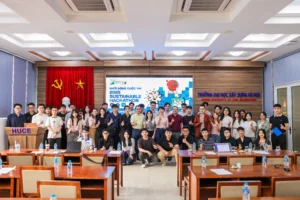
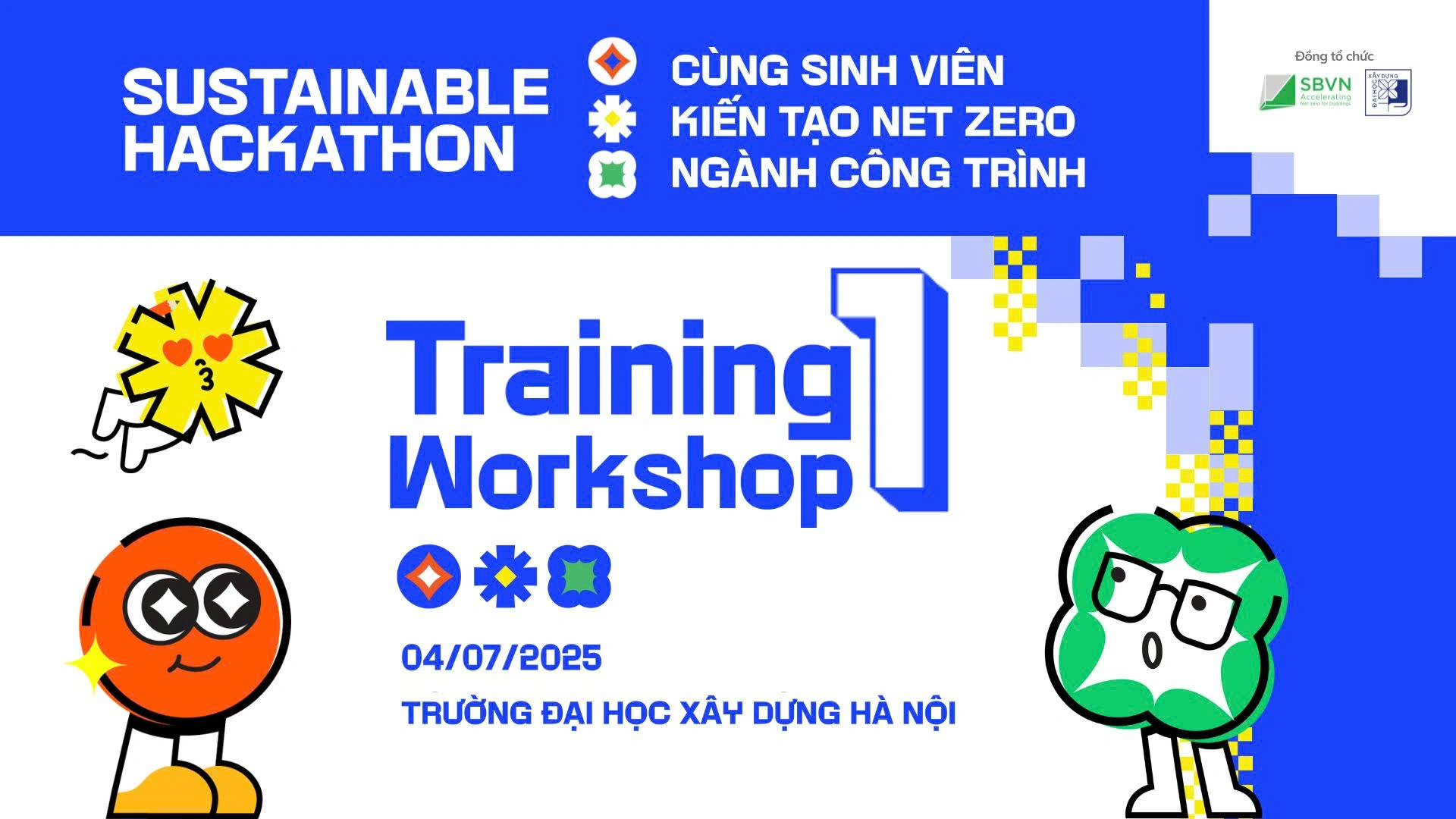
On the afternoon of July 4, 2025, the first Training Workshop within the framework of the 2025 Sustainable Hackathon competition was held online, with the participation of nearly 40 students from the fields of Architecture, Engineering, and Construction Economics at Hanoi University of Civil Engineering.
The workshop was run by the organizers of the Sustainable Hackathon, with professional support from two experienced speakers representing Edeec and Sen Vang Group:
- Mr. Tran Thanh Vu – Director of Edeec, an expert in energy simulation and building performance.

- Ms. Nguyen Thi Bich Ngoc – Founder of Sen Vang Group, a strategic consultant and expert in green real estate investment.

Economics – An Essential Pillar in Sustainable Design Mindset
Unlike traditional classroom lectures, this workshop tackled one of the most “critical yet often underrepresented” aspects for students in the construction industry: the economic efficiency of green buildings.
In the sharing session, Ms. Nguyen Thi Bich Ngoc, founder of Sen Vang Group, emphasized that the economic value of green buildings goes far beyond initial investment costs. It lies in lifecycle value, operational savings, and long-term competitive advantages.
“Investors today care not only about the numbers, but also about the design concept, operational costs, and how the building contributes to their brand image,” Ms. Ngoc shared.
Participants were introduced to key concepts such as Life Cycle Cost (LCC), Return on Investment (ROI), and the breakdown of capital, operating, and maintenance costs. They also explored how to build compelling financial arguments for green building proposals.
Energy Economics – From technical specifications and energy efficiency investments to simulation applications and data analysis in evaluating economic performance
Continuing the session, Mr. Tran Thanh Vu – Director of Edeec – broadened students’ perspectives on building operations and performance data in the valuation of green buildings.
He began his presentation by introducing the concept of energy economics — the process of translating technical specifications into tangible financial costs. This approach allows investors to clearly see the long-term benefits of implementing energy-saving solutions for lighting, air conditioning, and other systems.
Building on the discussion of operational cost optimization, he then shifted focus to technical factors that directly impact building performance, particularly glazing and the building envelope. Mr. Vu emphasized that a major portion of energy loss in buildings comes from solar heat gain through glass – especially in hot and humid climates like Vietnam. If the SHGC (Solar Heat Gain Coefficient) is not effectively controlled, even the best insulation materials won’t deliver optimal performance.
He shared:
“Glass and shading will likely be the decisive factors in energy-saving designs in Southeast Asian climates. You should pay serious attention to this issue rather than just tweaking bricks to reduce U-value. If you want real performance, reduce SHGC. Even top consulting firms are still struggling with this – it’s not just a student problem.”
To make performance assessment more practical, Mr. Vu introduced the OpenStudio energy simulation software, which allows for detailed analysis of building operation metrics such as electricity consumption, cooling load, and natural ventilation — all from the early design phase.
The workshop concluded with a dynamic Q&A session, where participants raised questions about balancing capital and operational costs, calculating payback periods from energy savings, and integrating simulation data into design documentation.
This is exactly one of the urgent issues facing design practice today — where every choice of material, system, or technical specification must be supported by clear economic data to convince investors and ensure the long-term sustainability of a building.

In the coming weeks, participating teams will continue with Training Workshop 02, scheduled for July 15, focusing on technical design and simulation. They will also receive in-depth support through a series of one-on-one mentoring sessions leading up to the proposal submission deadline on August 8.
At SBVN, we believe that nurturing a new generation of green engineers is not solely the responsibility of universities — it is also a shared mission for businesses in the construction industry. Participating in the 2025 Sustainable Hackathon is part of SBVN’s long-term commitment to bridging academia with real-world practice, fostering innovation, and supporting Vietnam’s national journey toward Net Zero.