
Introduction

| Location | Seattle, United States |
| Coordinates | 28°35’20.0″N 77°13’48.3″E |
| Occupancy Type | Office |
| Climate Type | Temperate |
| Project Area | 4,832 m2 |
| Date of Completion | 2013 |
| Grid Connectivity | Grid-connected |
| EPI | 29.57 kWh/m2/yr |
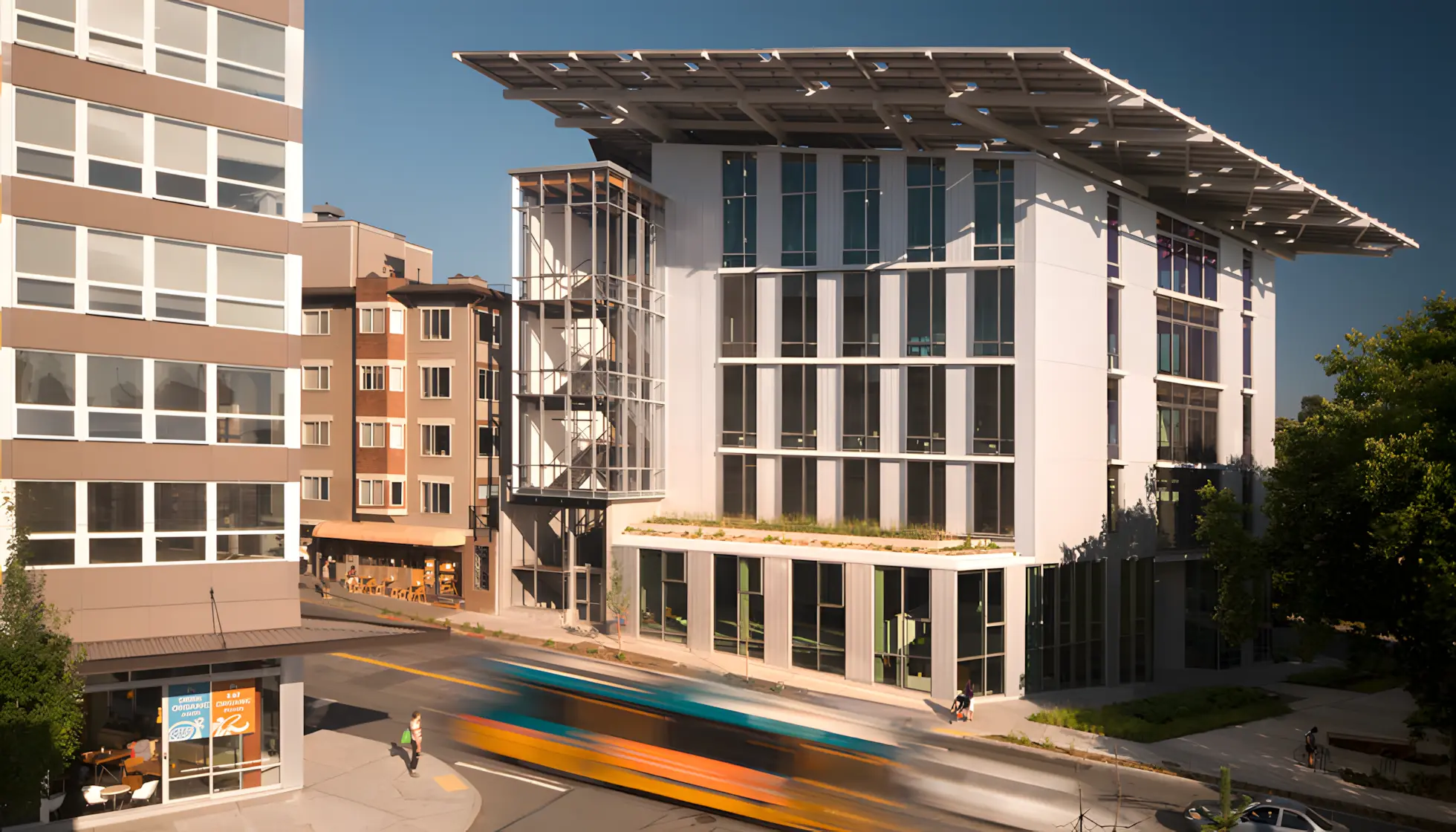
The Bullitt Center is a six-story office building in Seattle and is one of the greenest commercial buildings. This ‘living laboratory,’ designed by the Miller Hull Partnership, has received certification for Living Building, net-zero energy, and net-zero water from International Living Future Institute, 2015 Living Building Challenge. The Bullitt Center achieves net-zero energy through 100% on-site renewable energy generation using photovoltaic technology. The building also achieves net-zero water with a 50,000-gallon rainwater tank, efficient vacuum flush toilets, and an on-site constructed wetland to treat graywater before infiltration.
Design Strategies
Passive Strategies
Building Envelope
The exterior wall assembly of the Bullitt Center consists of a rain screen system, consisting of a metal panel, an air space, and 100 mm of mineral wool insulation (R-value = 2.83 m²·K/W). This assembly is fixed using fiberglass clips on the outer side of a 150 mm light steel-framed wall.

The latter is covered with 15.875 mm glass mat gypsum, housing fiberglass batt insulation, and is completed internally with a gypsum wallboard.
Daylight

The offices are located on the third floor and above to maximize natural light, offering better views, and isolation from public activities taking place below.
90% of the floor area receives adequate, and glare-free daylight during working hours.
Passive Cooling
The passive cooling system at the Bullitt Centre displaces approximately 750 hours of annual cooling that would otherwise be needed without operable windows. Motorized actuators open windows at night in summer, flushing the building with cool air to prevent overheating the next afternoon. Night-flush typically lowers the slab temperatures up to 15o C, allowing this mass to absorb more unwanted heat on warm summer afternoons.
Weather sensors located on the roof monitor rain, wind speed and direction, temperature, relative humidity, and sunlight. When occupied, windows automatically open if the outside temperature is above 18°C or the space temperature exceeds the adjustable setpoint of 22°C. If the outside air temperature is greater than 25oC or if the space temperature drops 2oC below the natural ventilation setpoint, then the windows close.
Active Strategies
Thermal Source and Supply Systems
The thermal production and delivery system at the Bullitt Center has both a source side and a supply side. The source side consists of a pair of pumps that circulate a solution of water and glycol (anti-freeze), through one of twenty-six. The pumps are located 121m deep wells, drilled directly under the building. Each hole is about 1.5 m in diameter, extending to the well’s bottom.

The building has five heat pumps. Three produce warm water in the winter, and occasionally cool water in the summer, to circulate through the floors for space heating or cooling. The fourth heat pump provides warm water in the winter to temper the incoming fresh air from the heat recovery air handler. The fifth heat pump is dedicated to water heating.
Ventilation
The primary ventilation for the building is through a dedicated outside air handling unit located on the roof. Fresh air is supplied by this system whenever CO2 sensors indicate the need for additional fresh air. This system is equipped with a heat recovery wheel located in the rooftop air-handling unit.
Building Control Systems

The building control systems are driven by direct digital control (DDC). This system monitors, logs, and controls the building’s mechanical heating and cooling systems, the supply and wastewater systems, air supply and exhaust systems, and sump pumps. This system also monitors, collects, and logs data from the weather station, indoor sensors, water meters, pump flows, thermal energy, fans, and window operations.
Renewable Energy
Renewable Energy Sources
The Bullitt Center generates as much electricity annually as it consumes. To accomplish this, the center is equipped with 575 solar panels on its roof, forming a 1300-square-meter array for electricity generation.

During the summer, the Center generates significantly more electricity than it consumes, while in the winter, the production decreases.
To effectively manage the surplus generated in the summer, the Center feeds excess electricity into the grid when Seattle’s demand is at its peak. Conversely, in the winter months with lower production, the building draws electricity from the grid. This strategy ensures that the surplus produced in the summer matches or exceeds the deficit in winter.